
The cost of certainty…
Why smart leaders make worse decisions the more certain they feel
Certainty feels like competence. The more sure you are, the more decisive you look, the more confidence you inspire in the people around you. But certainty and good judgement are not the same thing — and at the highest levels of leadership, mistaking one for the other is where blind spots quietly form. The leaders who make the best calls under pressure aren't the ones who feel most certain. They're the ones who've built a discipline of inquiry into how they think, especially when the stakes are highest.
The trap that looks like strength
Most leaders I work with didn't get to their level by being wrong often. They got there by being right — repeatedly, under pressure, in front of an audience. So when a new problem shows up, the instinct is to reach for what has worked before: pattern-match, apply the model, decide with conviction.
The trouble is that certainty is backward-facing by nature. It's built from what has already happened. The moment a leader stops questioning that model and starts defending it, they've stopped leading the situation in front of them and started leading the situation they're used to. That's not a character flaw. It's a legacy system — a way of operating that was built for a different set of conditions, still running because it worked once and nobody has audited it since.
Six shifts, one underlying pattern
Underneath almost every leadership stumble I've seen, one of six shifts had failed to happen:
From the search for certainty to the search for inquiry. The question isn't "what do I already know?" It's "what am I avoiding asking?"
From either-or thinking to both-and thinking. Competing truths can both be true at once — growth and caution, ambition and constraint.
From technical fixes to adaptive challenges. Not every problem is one to be solved. Some are patterns to be understood first.
From reactive control to responsive pause. The instinct to decide immediately is rarely the instinct that produces the best decision.
From blanket effort to targeted leverage. Not every part of the system needs equal attention. Some parts are simply more ready to change than others.
From cultural silence to cultural engagement. Are you creating space for the truth — or just space for your own answers to be confirmed?
None of these are separate tips. They're six expressions of the same underlying habit: treating certainty as the goal, instead of treating inquiry as the discipline.
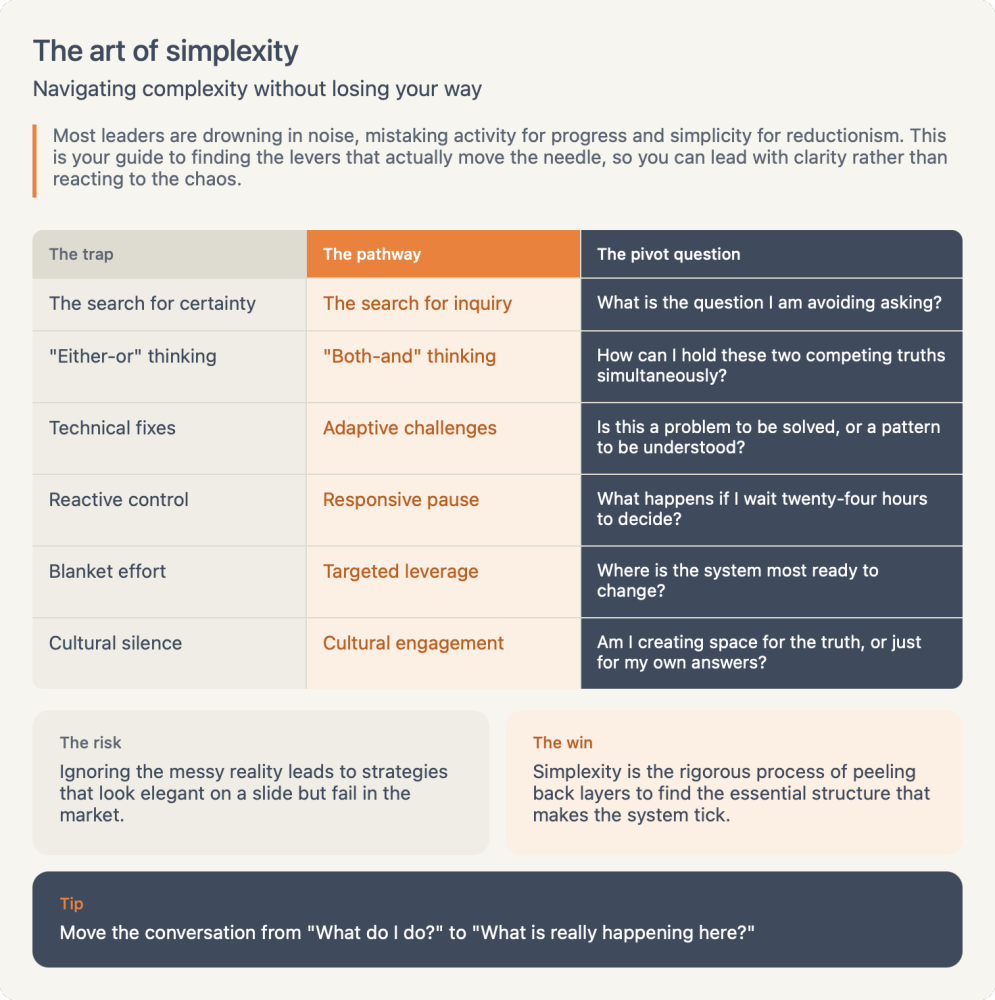
Use this as "cheatsheet" to help you think beyond the obvious.
The pivot questions in practice
I worked with a CEO who said to me, more than once, "past data predicts future performance." I understood exactly why he believed it — it's the very foundation of forecasting, and it had served him well for years. But we were working together specifically on change. And a model built entirely on the past has no room in it for the thing you're trying to create.
This is the technical-fix trap in its purest form. Forecasting from historical data is a technical fix — it's precise, defensible, and comfortable. But the challenge he was actually facing was adaptive: it required him to question the model itself, not just apply it more rigorously. The pivot question wasn't "what does the data say?" It was "is this a problem to be solved, or a pattern to be understood?"
That's the shift that doesn't show up on a slide. It shows up in the room, in the moment a leader is willing to say: the thing that got me here might not be the thing that gets me there.
What changes when you lead this way
This isn't about slowing down for its own sake, and it isn't simplification — stripping a problem down until it's easy to explain. It's the opposite. It's the rigorous, sometimes uncomfortable process of peeling back the layers of a complex situation until you find the structure that's actually driving it. Ignore that mess and you get a strategy that looks elegant on a slide and fails in the market. Do the work, and you get decisions that hold up under conditions your old model never anticipated.
Three things to do this week
Pick one live decision you're currently certain about. Write down which of the six pivot questions above you've been avoiding.
Before your next major call, build in a genuine 24-hour pause — not a delay tactic, a real space for the question to surface.
Ask one person in your circle whose job it isn't to agree with you: "What am I not seeing here?"
This is the exact territory The Cost of Certainty mastermind was built for — the audit of the internal operating system that most leaders never think to run. If this is landing, it's worth a conversation.
Framework adapted from the works of David Clutterbuck