
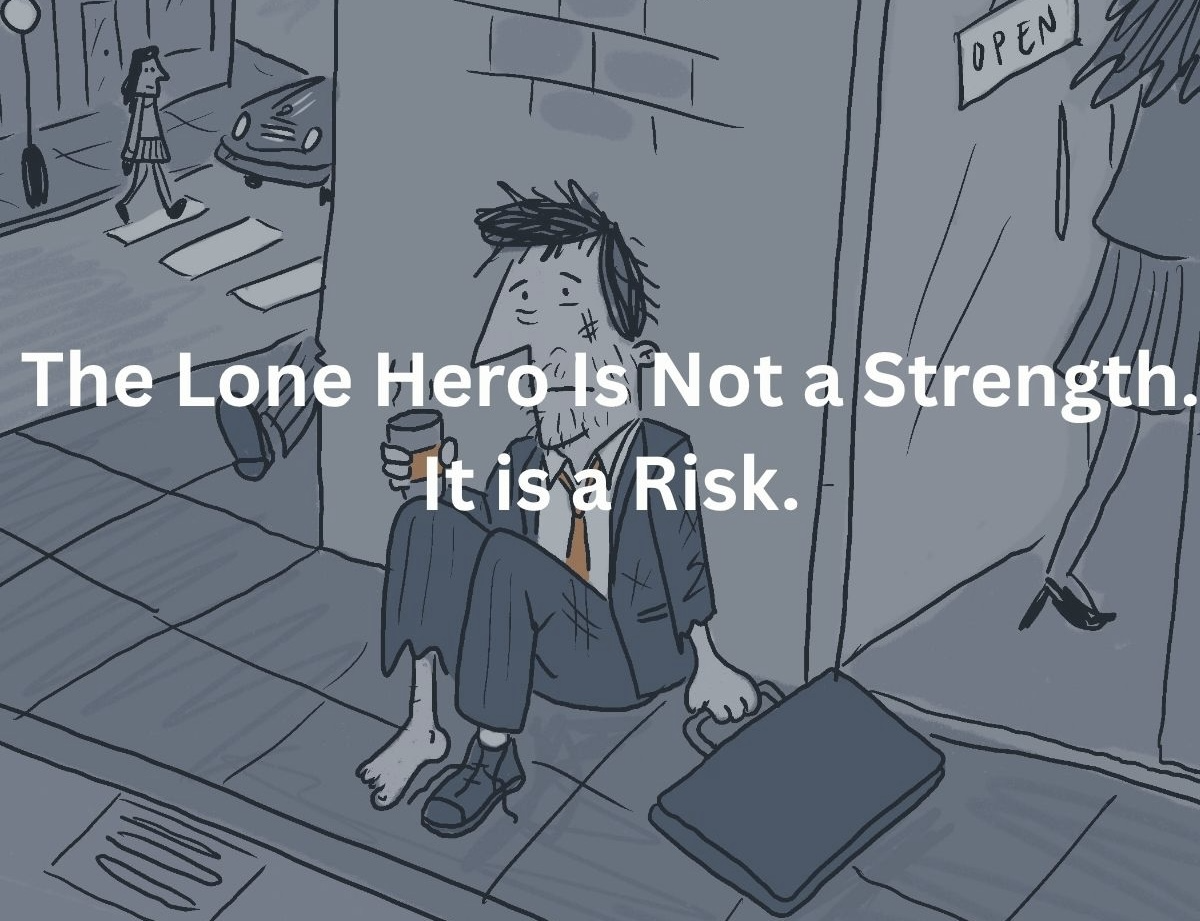
Even heroes forget the door swings both ways —he still hadn't gone in to ask...
What if asking for help is a leadership intervention that deliberately builds capacity in the system around you?
Just...Ask...For...Help...
Four words that terrify high performers more than failure does.
I posted about this recently— the fear sitting behind these 4 words, and why the leaders and high performers I work with will do almost anything rather than ask. That post landed harder than I expected. So I want to go deeper, because the real story isn't just personal. It's structural.
The identity trap
Most of the leaders I work with in boardrooms and in elite sport didn't arrive at the top by accident.
They got there by being the one with the answer.
The one who copes under pressure.
The one the team turns to when things go wrong.
Over time, that capability hardens into identity. You stop being someone who can solve problems and start being someone who must. And once "having the answer" becomes who you are, asking for help stops being a simple, practical act. It becomes a threat to your sense of self.
This is why so many capable people would rather absorb enormous personal cost — burnout, isolation, decisions made alone at 2am — than say "I don't know" or "I need help." It isn't weakness or ego in the way we usually mean it. It's a structural failure of identity, as they experience it. If the answers are supposed to come from me, then needing help means I'm not who I thought I was.
That's a deeply human, deeply understandable trap. It's also an expensive one — not just for the individual, but for everyone around them.
Consider a CEO I worked with who had built their entire reputation on being the ultimate problem solver. Their identity was wrapped up in one specific fact: they never needed to escalate an issue to the board, because they could always fix it themselves. That was the story of who they were.
The systemic cost of that identity became painfully clear when we looked at what was happening in the layer just below them. Because this CEO refused to delegate or ask for support, their senior leadership team had quietly stopped taking initiative. They'd learned, over time, that their job was simply to report status — not to solve problems — because the CEO would inevitably step in and override them anyway. The entire system became risk-averse and slow. The organisation lost its ability to innovate, because the CEO had effectively bottlenecked the collective intelligence of the company.
That's the identity gap made visible: one person's fear of needing help had become the whole organisation's ceiling.
It had been two days, but Andrew still didn't ask for directions.
The lone hero is a risk, not a strength
Here's where I want to shift the lens from the personal to the systemic, because this is where it really matters for organisations.
We tend to celebrate the leader who carries it all — the one who doesn't need anyone, who makes the call under pressure without flinching, who is always the calm centre of the storm. We call it strength. Resilience. Leadership.
But look at what's actually happening underneath that image. When a leader refuses to ask for help, they are, in effect, hoarding the decision-making process. Every judgement call stays locked inside one person's head. Nobody else in the system gets to see how the decision was made, question the assumptions behind it, or offer a different angle. Nobody else learns.
That's not resilience. That's a single point of failure, dressed up as virtue.
Organisations that quietly depend on a lone hero are more fragile than they look — not because the hero is incompetent, but because the system around them has never been allowed to develop the muscle to think, decide, and contribute alongside them. When that leader is stretched, distracted, or eventually gone, the capability goes with them.
Distributed accountability — genuinely sharing the weight of decisions, inviting challenge, letting others carry real responsibility — isn't a soft, nice-to-have version of leadership. It's the more robust one. It builds a system that can hold pressure from multiple points, not just one.
Reframing the ask
This is why I want to challenge a common assumption: that asking for help is a personal vulnerability you tolerate, at best, in service of being a "good," approachable leader.
I'd suggest something sharper. Asking for help is a leadership intervention. Done well, it isn't an admission that you've failed to be the source of answers — it's a deliberate act that builds capacity in the system around you. Every time you ask, genuinely, for another perspective, you are teaching your team that thinking is allowed here. That contribution is welcome here. That the answers don't have to come from one person.
That's not a smaller kind of leadership. It's a more distributed, more durable one.
The conversation you're actually trapped in
Underneath all of this sits something quieter — and this is the part I think matters most.
Most of the leaders I work with aren't stuck because of an external obstacle. They're stuck inside an internal conversation. A private, relentless loop of self-judgment: Will they think less of me? Am I supposed to have this figured out by now? What does needing help say about my competence?
That conversation happens entirely inside your own head. It's a dialogue you're having with a version of yourself, and an imagined audience, that you've never actually consulted. And here's the quiet tragedy of it: none of that internal rehearsal moves anything forward. It doesn't solve the problem. It doesn't build the team. It doesn't change the outcome. It just keeps you circling, alone, outside a door marked "OPEN."
The shift I want to offer you is this: stop having the conversation with yourself, and start having it with someone else.
External, collaborative dialogue — the kind where you actually say the thing out loud to a colleague, a mentor, a coach, a peer — is the only version of this conversation that moves the needle. It's uncomfortable, because it's real. But it's real precisely because someone else is now in it with you, which is the whole point.
This is exactly where the CEO I mentioned earlier was living two separate lives. Internally, they were trapped in a loop of self-limiting questions: If I show weakness, will they lose faith in my leadership? Can I afford to let anyone see the cracks? Externally, they were projecting an image of total control — which meant every conversation with their direct reports stayed purely transactional, devoid of any real vulnerability or collaborative problem-solving.
Two separate lives, running in parallel. And the gap between those two dialogues — the internal one nobody heard, and the external one that gave nothing away — was exactly where their burnout, and the organisation's stagnation, were quietly festering.
Where this leaves you
If you're carrying high performance and high-stakes responsibility, I want to leave you with this: the weight you carry is the reason to ask for help, not the reason to stay silent. Every decision you keep locked inside your own head is a decision your system never gets the chance to learn from.
The most durable leaders I know aren't the ones who never needed anyone. They're the ones who knew when to bring someone else into the room — and in doing so, built something stronger than they could have built alone.
So here's the real question, the one worth taking out of your head and into a conversation with someone else: what's the decision you're currently carrying alone that doesn't need to stay that way?